
For the last decade, SEO has been a game of text matching. You wrote “running shoes” in your backend, and Google served your page to people typing “running shoes.” It was a simple, transactional relationship.
That era is over.
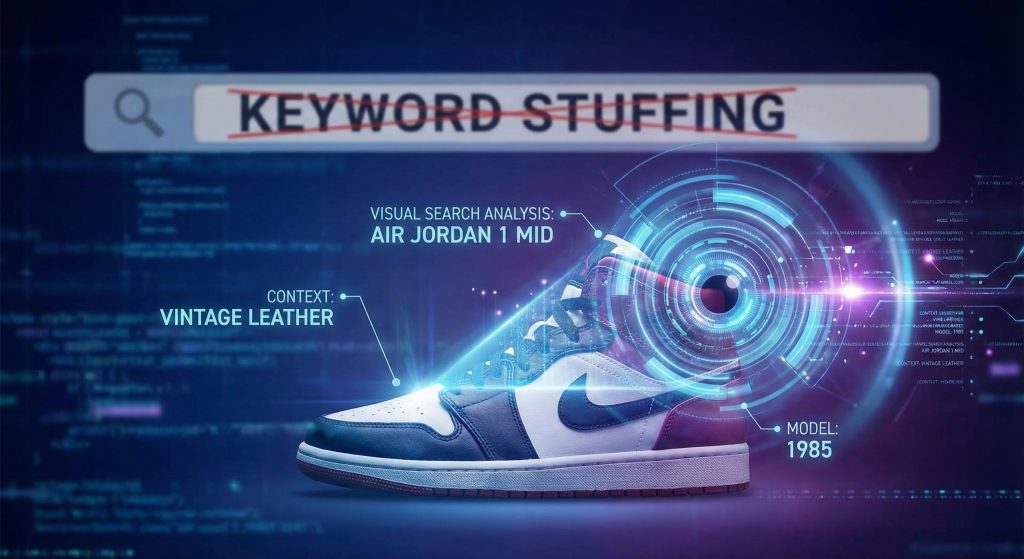
With the rapid integration of Google Lens and multi-search algorithms, the search engine is no longer just reading your code. It is looking at your images. And if you are still using 2018 tactics, like stuffing keywords into your Alt Text, you are feeding garbage data to the most sophisticated visual engine on the planet.
We analyzed how modern indexing works, and the results are clear: Google doesn’t trust your keywords anymore. It trusts what it sees.

The Problem: Most AI Is “Pixel Blind”
To understand why your current SEO strategy is failing, you have to understand how basic Computer Vision works.
When you use a generic bulk-optimizer app to generate Shopify Alt Text, the AI looks exclusively at the pixels in the image. It doesn’t know your brand. It doesn’t know your inventory. It simply identifies shapes.
If you sell a high-end, limited-edition sneaker, a standard AI sees a shape with laces and a rubber sole.
The result?
- Input: A photo of a 1985 Air Jordan 1 Chicago Colorway.
- Generic AI Output: “A red and white shoe.”
This tag is technically accurate, but for SEO, it is useless. It places your premium product in the same bucket as a $20 discount rack sneaker. You aren’t competing for “Vintage Jordans”; you are competing for “Red Shoe.” You will lose that fight every time.
The “Semantic Difference”: Context-Aware Engine
We identified this flaw early in development. The pixel data alone is never enough to generate high-ranking metadata.
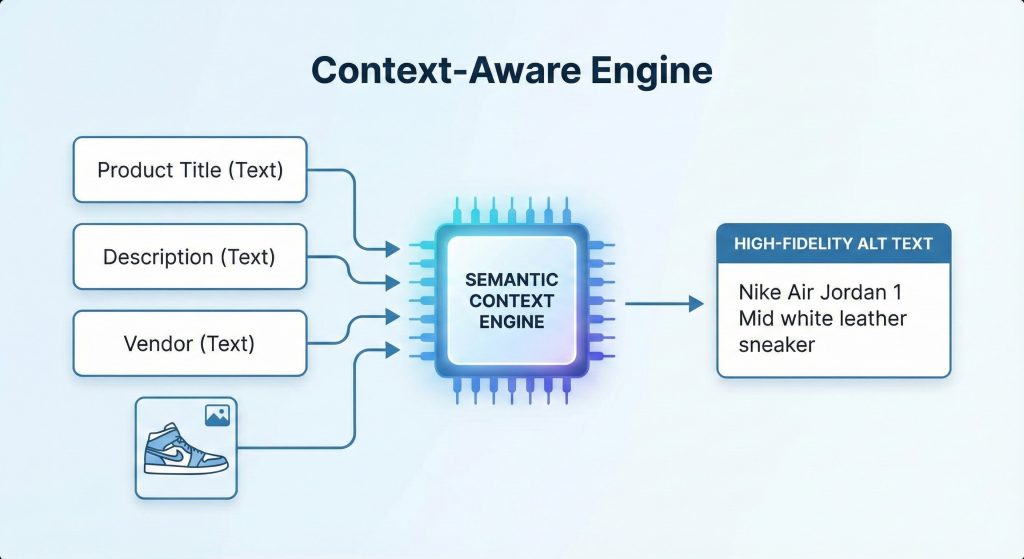
To solve this, we built a Context-Aware engine. Unlike basic tools that operate in a vacuum, our system reads your store’s “manual” before it looks at the product.
Before the AI writes a single word of Shopify Alt Text, it ingests:
- The Product Title: (e.g., “Air Jordan 1 Mid”)
- The Product Description: (e.g., “White leather,” “Men’s sizing”)
- The Vendor Name: (e.g., “Nike”)
It combines this text data with the visual analysis. It bridges the gap between what the product looks like and what the product is.
The Comparison: Which Tag Does Google Prefer?
Let’s look at the data. Below is a comparison of how a generic competitor tags a product versus how a Context-Aware system tags the same image.
Product: A white Nike Air Jordan 1 Mid.
- Competitor Tag (Visual Only): “White shoe on grey background.”
- Semantic Tag (Context-Aware): “Nike Air Jordan 1 Mid white leather sneaker for men shown from the side profile.”
The Verdict: The competitor’s tag is generic noise. It tells Google nothing about the brand, the model, or the material.
The Semantic tag matches the user intent. When a user searches for “Men’s white leather Jordan 1,” Google matches the query specifically to the image attributes. This is how you capture high-intent traffic from Google Images and Shopping.
Feature Highlight: The “Actionable” Mode (Stopping the Nuclear Option)
There is a dirty secret in the Shopify App Store. Most SEO apps offer a “Bulk Fix” button. It sounds convenient, but it is often a “Nuclear Option.”
When you click “Fix All,” those apps overwrite everything.
- They delete the bad tags.
- They also delete the good tags.
If you spent hours manually writing perfect descriptions for your best-sellers three years ago, a “Bulk Fix” will wipe them out and replace them with generic AI drivel.
We rejected this approach.
We developed Smart Bulk with an “Actionable” mode. instead of blindly overwriting your entire catalog, our system scans your current Alt Text first. It scores the quality of existing tags.
- If the tag is “IMG_9923.jpg”: We mark it as Empty/Junk and rewrite it.
- If the tag is “Red Nike Shirt”: We mark it as Weak and improve it.
- If the tag is already optimized: We leave it alone.
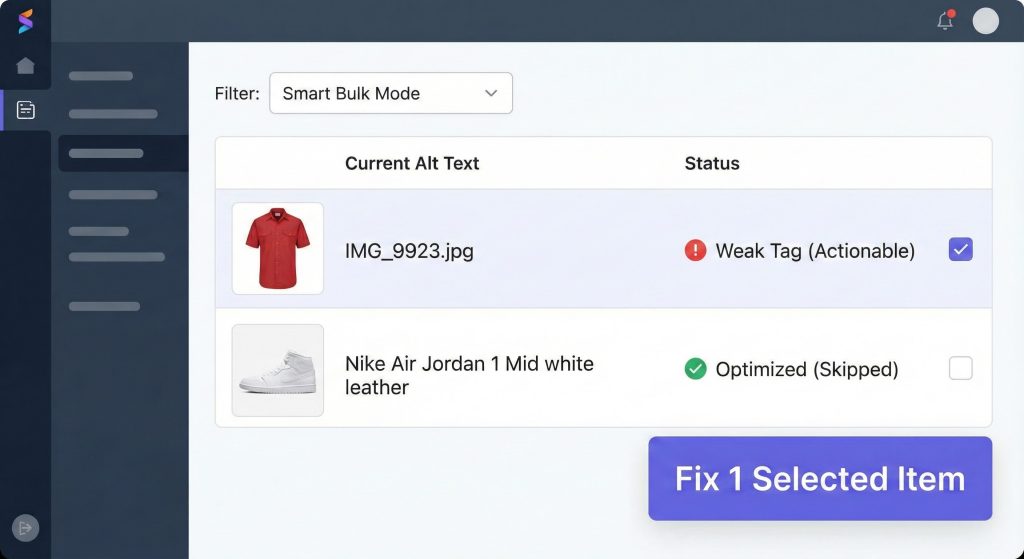
This allows you to target only the weak links in your SEO chain without destroying the foundation you have already built.
Conclusion
The days of tricking the algorithm are over. You cannot brute-force your way to the top of search results by stuffing keywords into hidden fields.
Google has eyes now. It knows when your text doesn’t match your image. The only way to win is to provide accurate, context-rich descriptions that help the machine understand your inventory.
Don’t let dumb AI define your products.
Technical Summary
- The Flaw: Pixel-based AI cannot identify brands or models, leading to generic tags.
- The Fix: Context-Aware processing (Visuals + Metadata).
- The Safety Net: “Actionable” filtering prevents overwriting high-quality manual work.
Ready to upgrade your visual SEO? [Run a Semantic Audit today].
