

You built a business to sell products. You didn’t build it to fund a predatory lawyer’s vacation home in the Hamptons.
But if you are running a Shopify store right now, you might be doing exactly that.
There is a threat lurking in your backend. It isn’t a hacker. It isn’t a supply chain collapse. It is the text hidden behind your product images.
Most merchants treat Alt Text as an afterthought. A chore. A place to dump keywords hoping to trick Google into ranking a product page higher. That lazy strategy used to be harmless. Today, it is a liability.
Web accessibility lawsuits are hitting record highs. Plaintiffs filed over 4,000 lawsuits against websites in 2023 alone. They aren’t targeting just the massive conglomerates anymore. They are targeting anyone with a checkout button and sloppy code.
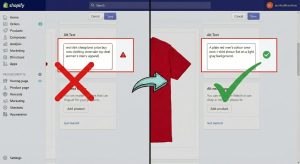
If your Alt Text says “red shirt cheap best price,” you are painting a target on your back.
The Trap: Keyword Stuffing Is Not SEO. It’s Evidence.
Let’s look at the old playbook. You upload an image of a dress. You want traffic. So, you write Alt Text that looks like this:
“Summer dress floral dress midi dress best women’s clothing store sale.”
To a search engine in 2015, that looked like relevance. To a screen reader used by a visually impaired person in 2025, that sounds like a stroke.
Screen readers read Alt Text aloud. That is their job. When a blind user navigates to your product, they need to know what the image depicts. They expect to hear: “Woman wearing a floral midi summer dress with short sleeves.”
Instead, your keyword-stuffed tag reads them a nonsensical grocery list of search terms.
This is the trap.
When you stuff keywords, you aren’t just creating a bad user experience. You are failing to provide equivalent access. That is the core requirement of the Americans with Disabilities Act (ADA). By prioritizing a search algorithm over a human user, you demonstrate negligence.
Lawyers know this. They use automated scripts to crawl thousands of Shopify stores. These scripts look for missing Alt Text or obvious keyword stuffing. If your site gets flagged, you don’t get a warning. You get a demand letter.
Settlements often range from $10,000 to $50,000. That doesn’t include your legal fees to fight it.
Google doesn’t care if you lose that money. Lawyers do.
The Solution: “Semantic” Is Your Protection Layer
You need to stop thinking about Alt Text as a marketing lever. You need to start thinking about it as insurance.
The goal isn’t to be clever. The goal is compliance. specifically, WCAG 2.1 compliance.
This creates a massive logistical headache. If you have 5,000 SKUs, writing descriptive, legally defensible Alt Text for every image is impossible to do manually. You don’t have the time. You likely don’t have the budget to hire a compliance firm to write them for you.
This is where Semantic enters the room.
We didn’t build Semantic just to help you rank (though it does that). We built it to keep you out of court. Semantic acts as a firewall between your lazy past habits and your future liability. It uses advanced AI to analyze your images and generate descriptions that satisfy strict accessibility standards.
It doesn’t guess. It observes. And it adheres to the rules that judges care about.
Feature Highlight: Context Aware (The “Vintage Nike” Factor)
Generic AI is dangerous. If you use a basic image recognition tool on a photo of a rare sneaker, the AI might just say: “A shoe on a white background.”
Is that accurate? Technically. Is it compliant? Barely. Is it helpful? Absolutely not.
If you are selling a 1985 Vintage Nike Air Jordan 1, “A shoe” is an insult to the customer. A blind user deserves to know exactly what is being sold, just as a sighted user does. If the sighted user sees “Air Jordan,” the screen reader must say “Air Jordan.”
Semantic is context-aware.
It doesn’t just look at the pixels in the image. It reads your Product Title and Description. It combines visual data with your existing catalog data to generate a description that is precise and rich.
- Bad AI: “Red t-shirt.”
- Semantic AI: “Men’s vintage heavyweight cotton t-shirt in crimson red with reinforced stitching.”
This distinction matters. WCAG guidelines demand that the text alternative serves the same purpose as the image. If the image sells the premium nature of the fabric, the text must convey that.
Semantic bridges the gap between what the camera sees and what the product is. It ensures that your visually impaired customers get the full sales pitch, not a watered-down generic label.
Feature Highlight: Fixing the Junk (The “IMG_9923” Problem)
Open your media library. Scroll down to your older uploads. What do you see?
IMG_5543.jpgScreenshot_2024-01-12.pngasdf.jpg
We all do it. We rush to get a product live. We upload the file straight from the camera or the manufacturer. We tell ourselves we will fix the file name later.
We never do.
For a screen reader, a file name like IMG_9923.jpg is a dead end. Sometimes, if Alt Text is missing entirely, the screen reader will read the file name aloud to the user. Hearing “Image nine nine two three dot jay peg” tells the user nothing. It screams incompetence.
Even worse are the “keyboard smashes”—when a hurried uploader just hits random keys to save a file. jkfdsl.jpg.
Semantic hunts these down.
Our system identifies these accessibility failures immediately. It recognizes that IMG_9923 is not a descriptor; it is a placeholder. It sees asdf for what it is—garbage data.
Semantic treats these “junk” tags as empty gaps. It targets them for immediate remediation. It scans the image, reads the context, and replaces the gibberish with a structured, compliant sentence.
You don’t have to audit your library of 10,000 images to find the file name errors. Semantic does the audit for you. It finds the legal cracks in your foundation and fills them with concrete.
A Two-for-One Win
I promised I was pragmatic. I hate spending money on things that don’t generate a return.
Buying a “compliance audit” from a law firm costs thousands and earns you zero new customers. It is a sunk cost. It is purely defensive.
Semantic is different.
When you fix your Alt Text for ADA compliance, a strange thing happens. Google starts to love you.
Search engines have evolved. They have stopped falling for keyword stuffing, too. Google’s modern algorithms (like the helpful content updates) prioritize clarity, context, and user experience. They want exactly what the blind user wants: an accurate, descriptive explanation of the image.
By using Semantic to protect yourself from lawsuits, you are accidentally executing the perfect SEO strategy.
- The Compliance Officer is happy because the risk of a lawsuit drops.
- The Marketing Director is happy because organic traffic increases for long-tail keywords.
You fix the legal time bomb ticking in your backend, and you get better rankings as a bonus.
Don’t wait for the demand letter to arrive in the mail. By then, it is already too late. Fix your “Red Shirt” problem today.
Action Plan: Secure Your Store
- Audit: Check your top-selling products. Does the Alt Text describe the image, or is it a list of keywords?
- Clean: Look for file names serving as Alt Text (e.g.,
IMG_001.jpg). - Automate: Install Semantic. Let the AI read your context and write the protection layer you need.
Stop gambling with your liability. Start describing your products.
